
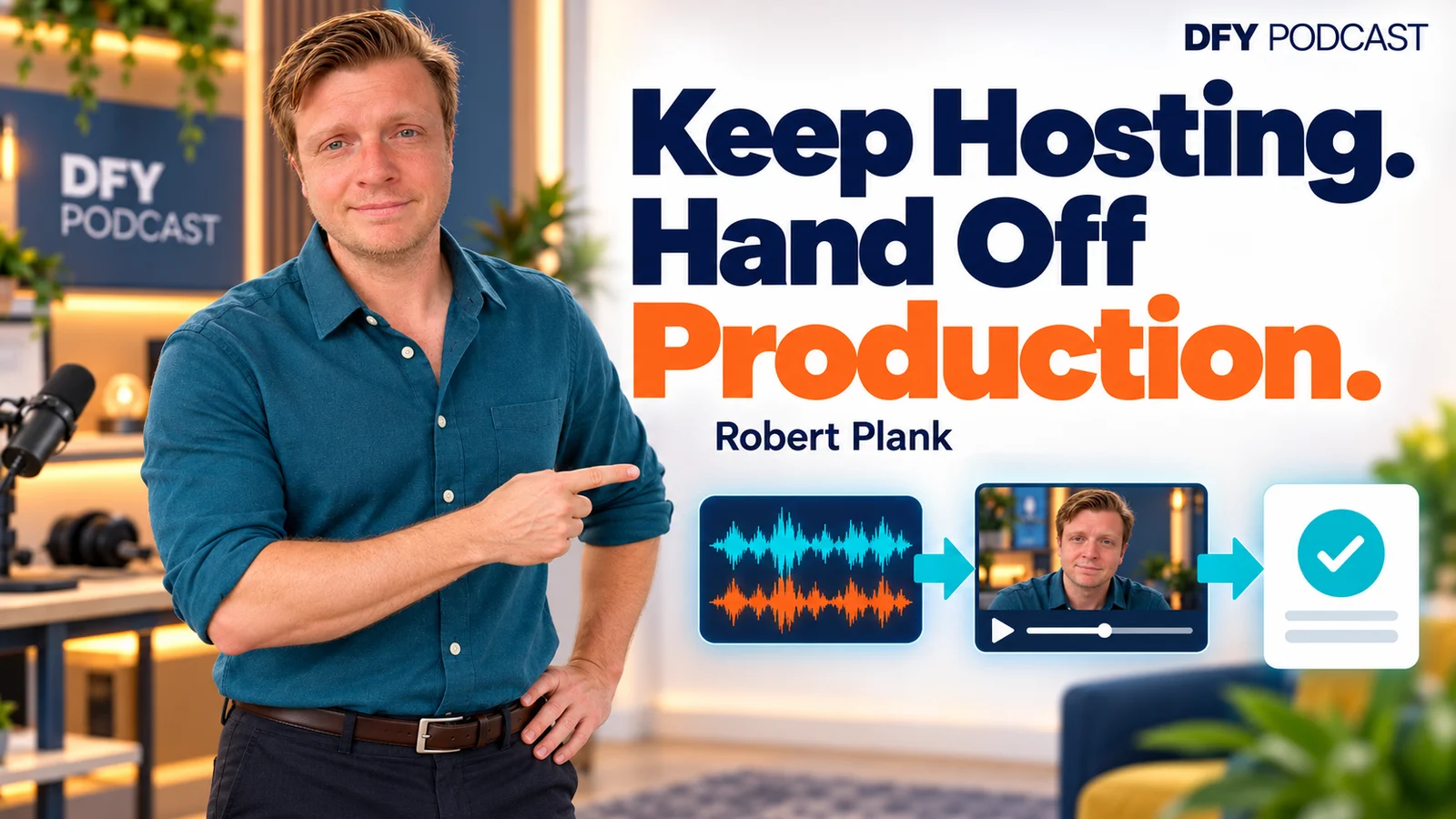
How to Outsource Podcast Production and Keep Time for Your Guests
During my “Just One Client” presentation, an audience member considering a podcast put it plainly: “I don't want no more work.” You might want a regular reason to talk with potential referral partners, prospects, and people whose ideas interest you. The hesitation comes when you picture everything afterward: editing the recording, writing show notes, uploading the episode, and making something worth sharing.
If you handle all of that yourself, every guest you invite creates another production assignment. You can outsource podcast production, but you still need to decide what you’re handing over and what stays with you. Choosing appropriate guests, preparing, recording, and following up personally still require your attention.
I like interviews because I get to know someone through the conversation. Finishing and sharing that conversation gives us another reason to stay in touch, but the recording has to become something we can actually use. A workable arrangement starts with knowing what you’ll record, what files and instructions your team needs, and who handles the episode through publication. That lets you judge the commitment before filling your calendar with guests.
Watch the presentation behind this guide. The audience Q&A includes the concern that starting a podcast could create more work.
What You Still Take On as the Host
Before someone comes on my podcast, I like to meet for ten minutes. A few minutes before that call, I check their LinkedIn profile and look for previous YouTube appearances. Then we talk about what they’re working on, their current focus, and whatever else comes up. By the time we record the interview, we’ve already had a conversation and know a little about each other.
You can use a short pre-call to work out whether there’s a useful conversation to record. Start with why you want that person on your show and what your listeners could get from hearing them. A potential referral partner might be a suitable guest, but you still need a subject worth discussing. Ask for their bio and think about which parts of their experience you want to explore.
During the interview, I’m looking for stories: people they’ve helped, things that went wrong, and how they worked through those problems. That requires listening and asking follow-up questions. You might prepare a few questions, then hear something that deserves more attention than the next item on your list. The host makes those decisions while the conversation is happening.
Your calendar needs to account for that involvement. If you decide to publish weekly, consider whether you can find suitable guests, prepare, record, and respond to production questions at that pace. Set aside time for the personal follow-up you intend to do, too. A production team can work with the recording you supply, but you still have to make the appointment and have the conversation. Choose a schedule that fits those responsibilities before sending a large batch of invitations.
An existing show also gives you somewhere to test interviews. During the Q&A, someone asked about adding guests to a show that had used a different format, and whether that meant starting a second podcast. My advice was to try the interviews within the existing show.
You can mix solo episodes with guest conversations, see how the format suits you, and adjust. Starting another show creates another publishing commitment, so make that decision deliberately. For a stalled show, I’d begin with a recording schedule you can manage now and a few guests you have a good reason to interview. You can decide whether to record more often after you’ve completed those episodes.
- You RecordPrepare, ask useful questions, and listen.
- You Hand OffSend complete files, guest details, and clear instructions.
- The Team ProducesEdit, prepare the episode material, and publish to agreed channels.
- You Follow UpShare the finished conversation and keep in touch personally.
Agree on reviews and publishing responsibilities before the next recording.
How to Outsource Podcast Production With a Clear Division of Work
Start by deciding where you want the production team’s responsibility to end. An edited audio file still needs a title, show notes, an upload, and whatever promotional material you intend to use. Agree on the finished work you expect before assigning the next episode.
If you hire someone only for editing, those other tasks still need an owner.
Robert Plank
For a show you host, I recommend a division like this:
| Part of the work | Your responsibility | Production work to assign |
|---|---|---|
| Recording | Prepare and record the conversation | Work from the recording you supply |
| Editing | Identify required changes and explain your preferences | Edit the audio and video to those instructions |
| Episode material | Supply accurate guest details and relevant links | Prepare show notes, transcripts, clips, graphics, and promotional copy |
| Publishing | Agree destinations and any required approvals | Upload and publish to the agreed channels |
At DFY Podcast, our podcast production services combine those editing, written-content, publishing, and promotional tasks. We work with new shows and existing podcasts. During onboarding, we agree on the presentation, editing preferences, account access, and items you want to review. Instructions, questions, and feedback stay together in Slack.
Guest outreach is a separate scope decision. Starter and Growth cover production, while Authority adds specified strategy and guest outreach support. My own routine of pre-calls, personal follow-up, and looking for referral opportunities shouldn’t be treated as a list of services every production plan includes. Choose the support you need based on the responsibilities you actually want help with.
Our podcast production cost guide compares the plans and the work each one covers. Use it to budget for the tasks you actually want to assign.
You can also retain specific decisions without reviewing every small production choice. Perhaps you want to approve the episode title, or there’s a sensitive passage that needs your attention before publication. Tell the team which decisions require you and which they can make according to your established preferences. If you want fewer filler words removed or a more conversational edit, say that explicitly.
Those approvals need room in the release schedule. If an episode is waiting for your decision, assigning the editing to someone else won’t resolve the unanswered question. Decide who can approve it and when they’ll respond. You can then review the agreed items instead of reopening the entire production approach with each recording.
Give Your Production Team What They Need to Finish
My approach to equipment is to start with sufficient lighting and sound, record some episodes, and upgrade as I go. Check which microphone is being recorded and listen to a short test before the conversation starts. Make sure both people can be heard and that anything you show on camera is visible enough to understand.
Afterward, send the complete original recording, along with separate speaker tracks when available. Check that the person receiving your file link can open it. For Google Drive, use Google’s file-sharing instructions to check the recipient’s access and download permissions. A recording sitting behind an access request is still waiting for a handoff, regardless of how much editing capacity you’ve arranged.
For a reusable format, use our podcast editing handoff checklist. Keep the recording, guest details, and instructions together.
Alongside the recording, I recommend supplying:
- The guest’s correctly spelled name, bio, website, and relevant resource links.
- Timestamped cuts, corrections, and anything that must stay off the published episode.
- Required intro, outro, sponsor messages, and current brand assets.
- The requested publishing date and destinations.
- Any episode-specific decision or approval the team needs before release.
Be specific about changes. If you discussed something privately after the interview ended, identify where the publishable conversation stops. If the guest corrected a name or fact later in the recording, flag that correction. These instructions give the editor something they can act on without guessing what you intended. Check that an edit preserves the meaning of the exchange, especially when removing part of an answer.
The written material needs useful information, too. Show notes should explain what the conversation covers and help someone find the guest or a resource mentioned during the interview. Supply the actual destination for an offer rather than expecting someone to reconstruct it from a spoken name. When reviewing a transcript or generated copy, check names, links, quotations, and claims against the recording. A plausible spelling or confident summary can still be wrong.
For a promotional clip, listen to the surrounding conversation before choosing the excerpt. Does the answer make sense without the question? Does it depend on a diagram the viewer can’t see? A short clip worth sending your guest should preserve what they meant and give someone enough context to follow the idea. Whether the guest shares it remains their decision.
If you have several recordings waiting, give the team a publishing order. That’s particularly useful when one conversation mentions a dated event or offer. The team then has a usable recording, accurate information, and explicit priorities to work from.
Finish the Episode and Keep the Guest Informed
I’ve been the guest wondering whether an interview ever came out. In one case, I emailed a host about a conversation we’d recorded the previous summer. I’d been searching my name and looking through his show, asking, “Where is it?” His answer was an unlisted YouTube video. We’d had the conversation, but I still had to chase down what happened to it.
Decide who will confirm that an episode is published and who will send the guest the public link. Include that responsibility when you arrange production. Check the destination before passing it along so the guest receives something they can actually open and use. A scheduled upload, a private review link, and a publicly available episode are different stages of the work.
In my own routine, I publish the conversation, tag the guest, and put out excerpts and graphics. Later, I can reconnect around something we’ve already done together. I might ask what they’re working on now or whether there’s someone I could introduce them to. The episode gives that message a specific starting point. I can refer to the conversation and send material featuring their ideas.
You can make the guest’s part straightforward by sending the finished link and identifying any accompanying material they can use. If someone on your team handles that delivery, make sure they know what to send and where to send it. When a guest asks me for raw footage, I’m happy to share it before my episode is out. For your own show, agree on what you’ll provide and when, especially if the guest asks while you’re still recording.
Personal follow-up needs its own owner.
Robert Plank
Preparing an episode email or a social caption doesn’t settle whether you should make an introduction, arrange another conversation, or discuss working together. Those decisions depend on what you learned about the person and what you’ve agreed to do. If you promised a connection during the interview, put that action somewhere you’ll see it rather than leaving it buried in the recording.
Leave room to respond when the guest replies. A production team can help prepare and publish the material, while someone who knows the guest remains responsible for the personal conversation.
Decide What You'll Own Before the Next Recording
Take the next episode you intend to record and assign responsibility for getting it published. Decide what you’ll supply, who will handle production, and which decisions need your approval. Put a realistic release date beside it. That gives you a specific commitment to assess before you invite more guests or increase how often you record.
If you already have recordings waiting, look at where they’ve stopped. Perhaps the edit is unfinished, the guest’s information is missing, or an approval has been sitting with you. Assign that recurring task and give the person responsible what they need to complete it. For a new show, make those assignments before the recordings start accumulating.
YOUR NEXT STEP
Keep the Guest Relationship. Hand Off the Production.
You still need room to prepare, record, and follow up. If you want a team to handle the work after the conversation, compare that division of work with what DFY Podcast provides. Our production page walks through the editing, episode material, publishing, and plans so you can decide what to hand over.
Explore Podcast ProductionSee the process, deliverables, and production plans.
About Robert Plank
Robert Plank is the founder of DFY Podcast and host of Marketer of the Day. He interviews entrepreneurs and business owners about their experiences, work, and lessons learned. Through DFY Podcast, he works with a team providing editing, show notes, publishing, and promotional materials for new and existing podcasts. His production experience includes creating show notes for Anthony Trucks’s podcast, a collaboration he discussed during the presentation.