
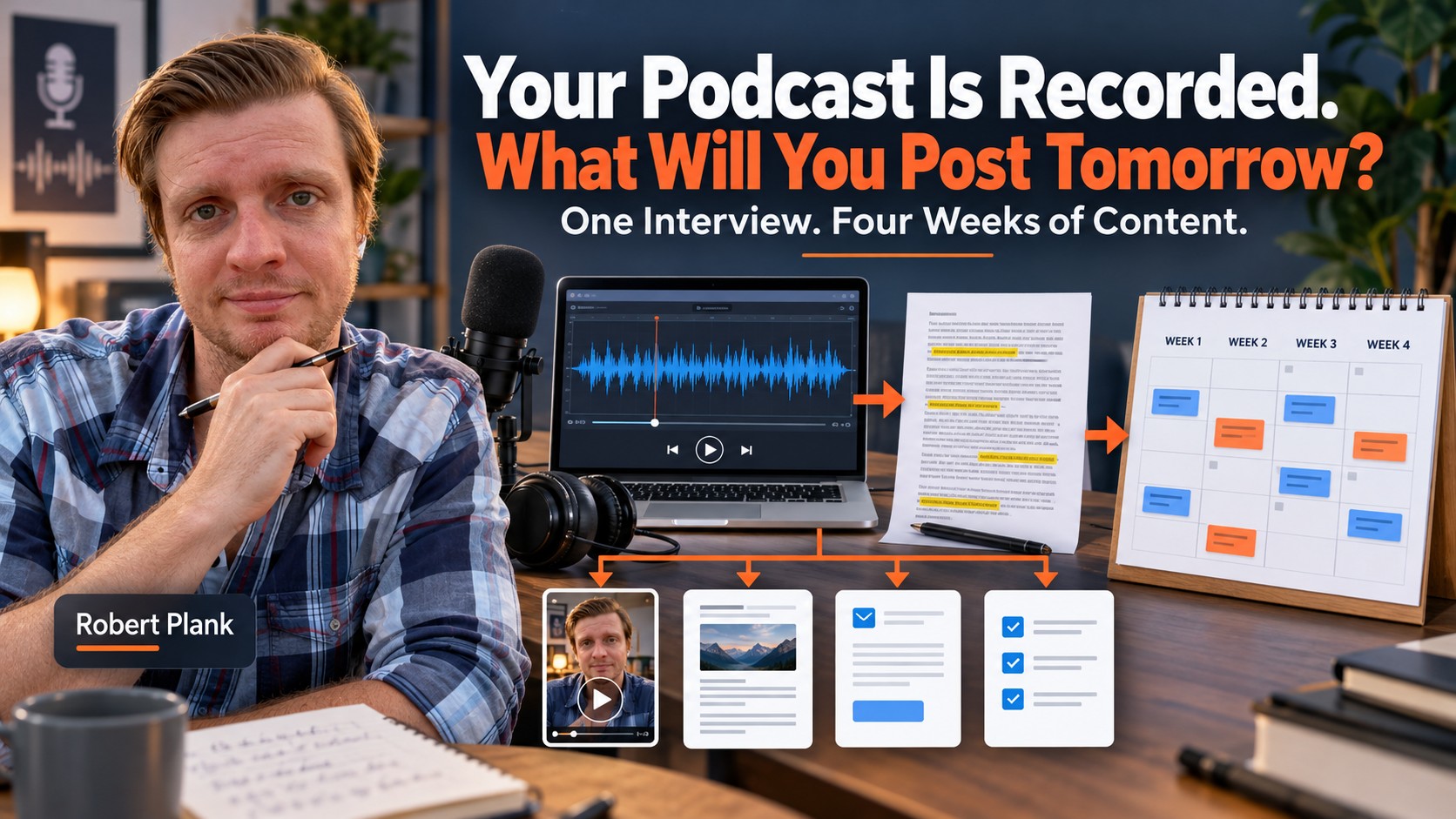
How to Turn One Podcast Interview Into a Month of Content: A Practical Four-Week Publishing Plan
You've finished the interview, published the episode, and tomorrow's content calendar is empty. The recording may contain the answer. The trouble is that nobody has turned that answer into a specific assignment.
Consider a hypothetical bookkeeping consultant interviewing an accountant about changing providers. The conversation covers gathering records, avoiding delays, choosing a replacement, and managing the handover. Those are different customer questions. They don't need to become twenty announcements that a new episode is available.
A month of content means a manageable plan for using the answers, not a requirement to post every day. I'd rather publish six useful pieces than fill thirty boxes with slightly different requests to watch the same recording.
Put the four-week plan where you can see it
Here is an editorial illustration for that bookkeeping interview. It isn't a client result or a calendar a guest prescribed. Change the output to match what the recording actually supports and what your team can finish.
| Week | Reader's decision | Possible material |
|---|---|---|
| 1 | Do I recognize the problem? | Complete episode page, one useful introductory clip, and an email saying who the conversation helps |
| 2 | What do I need to prepare? | A document-preparation checklist and a separate answer about a delay discussed in the recording |
| 3 | How do I evaluate the options? | One focused article on questions to ask a prospective provider, if the interview answers them |
| 4 | How do I handle the transition? | A practical handover answer, a short connecting email, and a review of questions received |
If the interview doesn't cover choosing a new provider, leave that proposed article out. Use a stronger answer or record a properly researched follow-up. An empty slot is better than advice invented to complete the calendar.
For your first attempt, reduce the assignment to one episode page, two clips, one written answer, and an email. Finish those before expanding. The table is useful only if it helps people understand what needs to get published.
- 1. Choose the customer questionStart with the problem the recording can actually explain.
- 2. Mark complete answersKeep the source location and necessary qualifications with each idea.
- 3. Assign the right formatsGive each clip, article, checklist, or email a distinct purpose.
- 4. Publish and reviewSchedule approved work, then use relevant responses to choose the next answer.
Record answers worth extracting
You need some direction before recording. For the bookkeeping example, the main question might be how a business can change accountants without disrupting the work. Supporting questions can address preparation, selecting the new provider, and arranging the handover.
That doesn't require a script. In our conversation on podcast interview marketing, Tom Schwab described how natural conversations can supply useful content in several formats. An expert may explain an idea more easily in response to a question than by facing an empty document.
Follow-ups do the important work. What happens when someone forgets that step? What usually causes a delay? When would the recommendation change? Those questions produce material an editor can use without stripping away its meaning.
Agree on the intended reuse with your guest. The recording, excerpts, and written material shouldn't come as a surprise. Keep the original files and a reliable transcript available to the people preparing the assets.
The transcript still needs editing. Spoken answers repeat themselves, depend on earlier questions, and sometimes contain a qualification outside the excerpt someone initially chose. You need a finished explanation, not a tidied transcript pretending to be an article.
Find complete answers before choosing formats
Read for the question being answered. Then mark the speaker, source location, main point, and context that must remain attached. Those details turn an interesting timestamp into an assignment.
In the hypothetical interview, a sentence about missing records may sound perfect for a clip. Check whether the accountant explains which records and which circumstances they mean. You may need a longer excerpt for the advice to make sense.
Tom discussed audiograms, quotes, cleaned transcripts, and focused articles as possible outputs. The underlying idea needs to support the format. A quote can introduce a thought without teaching the entire process, and one substantial answer may work better as an article than a short video.
I've discussed the different sizes of content inside an interview with Frank Husmann. His work with B2B SaaS experts involved identifying buyer questions, producing useful explanations, and learning from the response. The transferable habit is choosing the format for the thing someone needs to understand.
For our example, a clip can explain one cause of delay. A checklist can organize preparation. An article can compare questions to ask a provider. Each should do a distinct job. If two proposed pieces say almost the same thing, combine them.
Give the full episode a useful home
Lyndsay Phillips emphasized the episode page in our conversation about promotion and production. Give the recording a place on your website with the relevant player, explanation, guest information, and a sensible next step.
Someone looking for one answer shouldn't need to listen from the start to discover whether you've addressed it. Clear subheadings and timestamps can help visitors find the relevant discussion and return to its context.
That page becomes the reference point for the smaller pieces. A social post can introduce a problem and direct someone to the fuller answer. The email can say why a particular recipient would care rather than merely announce that the guest is wonderful.
Lyndsay's question about benefits is a good check before publishing. What does this person get from opening the piece? The fact that you recorded another interview isn't, by itself, their reason to pay attention.
Give each piece a job before you give it a publishing date.
Make the editor assignment concrete
"Make some clips" leaves the source, audience, context, deadline, and review decision to whoever receives the instruction. You may get polished work that doesn't do the job you intended.
A useful hypothetical assignment is more specific: "Use the marked answer about missing records for next Tuesday's LinkedIn post. Keep the sentence explaining when it applies. Prepare the clip and captions for factual review before scheduling."
The assignment should identify the source location, question, format, destination, due date, and reviewer. Someone also needs responsibility for publication after approval. Otherwise, a finished edit can sit in a folder while everyone assumes someone else pressed the button.
Use a checklist for the repeatable checks: names, speaker attribution, numbers, captions, context, links, and the approved version. The reviewer needs the actual files going live, not an earlier draft with a different headline.
We help organize this work at DFY Podcast. You can see the kinds of outputs involved in our production samples. The useful question is which of those outputs your interview supports and your audience needs, not how many you can put in a package.
Review the question behind the numbers
Suppose one clip receives 2,000 views and no conversation, while a checklist receives 75 visits and three relevant questions. Those hypothetical results don't tell you which piece won until you know what each was meant to accomplish.
The clip may have introduced the subject. The checklist may have helped someone already preparing to act. Look at the evidence you have rather than automatically calling a view a lead or a reply a sale.
Frank discussed reviewing response before deciding what to produce next. Borrow that habit. If people ask which records to request from a former accountant, you have a specific subject to investigate for another answer. If the existing explanation confused them, a clearer example may be more useful than another topic.
Also watch whether increased promotion remains welcome. Lyndsay recommended monitoring email opt-outs when discussing promotion. More output isn't automatically more useful contact.
Before commissioning another interview, check whether an earlier episode answers the new question. Verify that dates, software instructions, requirements, and service details still apply. Reusing an old explanation doesn't excuse publishing outdated guidance.
Related conversations and resources
Finish one assignment before expanding the calendar
Open one existing interview and choose one complete answer your prospective customers would use. Mark its location, decide the format, and give the assignment an owner and publishing date. The rest of the four-week plan can follow once that piece is working its way through the process.
If the source is good but preparing, checking, and publishing the outputs is where you stall, that's a production problem. We don't need another interview to diagnose it.
Bring your recording and the question it answers to our podcast production page. At DFY Podcast, we'll discuss the episode page, excerpts, written material, and publishing work that would put that conversation to use over the coming month.