
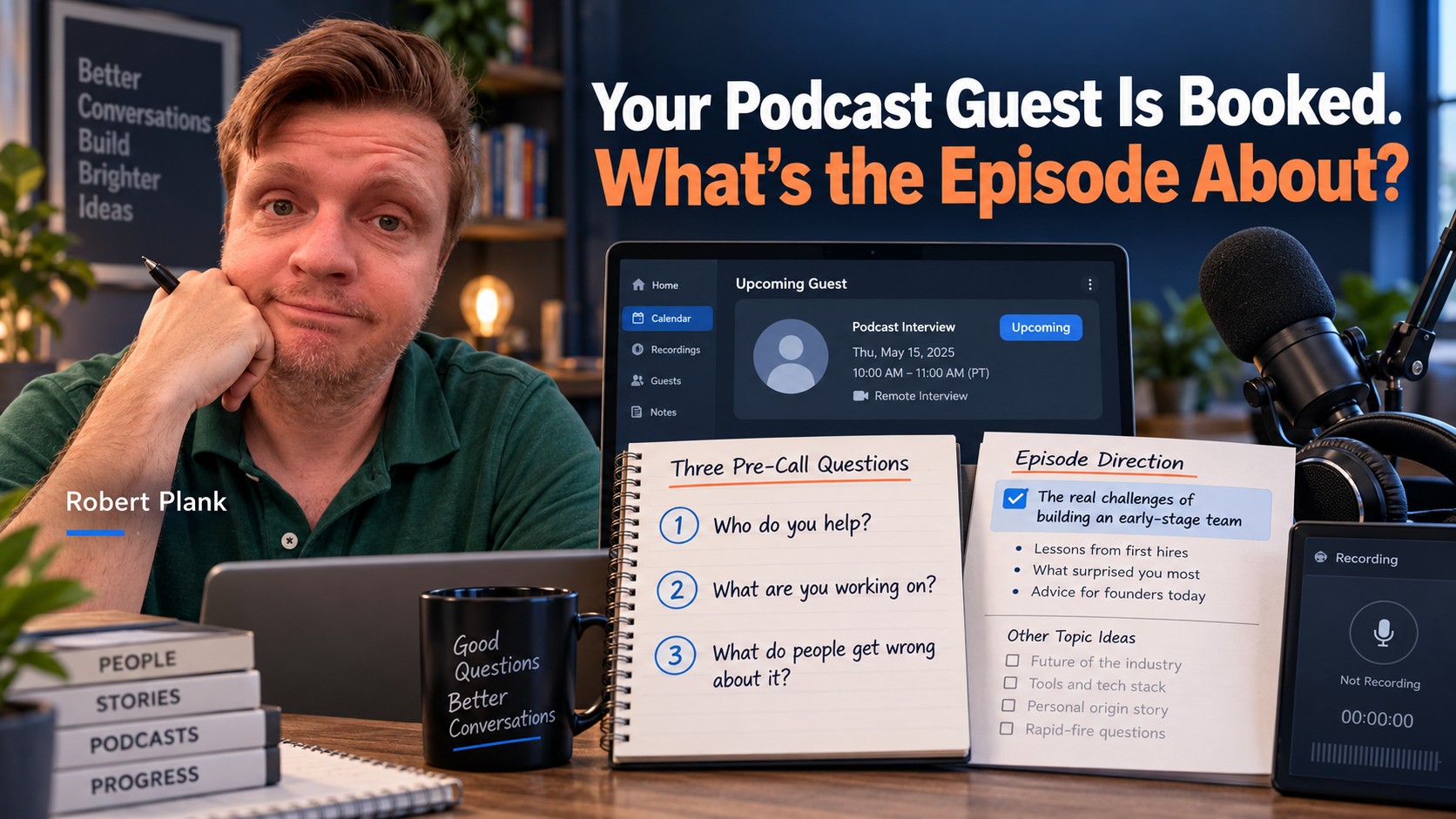
Three Podcast Pre-Call Questions That Lead to Better Interviews
Your guest is booked for Thursday. You have their biography, a recording link, and five possible subjects. They've written a book, built a business, and spoken at conferences. You still don't know which question the episode should answer.
I use a short pre-call to find that direction. Three questions do most of the work: "Who do you help? What are you working on? What do people get wrong about it?" The answers often tell me more than another page of professional accomplishments.
I generally allow ten to fifteen minutes. I'm getting acquainted, looking for a worthwhile subject, and deciding whether we're a good fit. The result should be one episode angle, a couple of stories to explore, and a clear next step. The full interview can wait until we're recording.
Ask, "Who Do You Help?"
"Business owners" is a starting answer, but it doesn't tell me much. Which owners, and what's happening when they need help? Someone starting a first company has different questions from someone managing ten employees or making sales while running short of cash.
My follow-up might be, "What's usually happening when someone comes to you?" Then I want to know what that person needs to be different afterward. I'm trying to find a situation a listener could recognize.
Imagine an operations consultant who helps founders still answering every customer-support email. This is a fictional example. They started doing it when the company was small and kept doing it as sales grew. Now they need to hire help, document answers, and trust another person without checking every message.
That's a more useful subject than "business systems." We could explore how the founder recognizes the bottleneck, what to document, and which mistakes happen during the handoff. The guest's expertise hasn't changed, but we've found a problem worth examining.
This also helps me judge audience fit. A knowledgeable person may serve customers whose questions don't overlap with the show's listeners. Sometimes another angle connects the two. Sometimes another show is the better place for that interview.
I wouldn't require the guest's customers and my audience to be identical. A restaurant owner and a software developer can both explain the experience of hiring a first employee. Look for a shared decision without pretending the businesses are the same.
Ask, "What Are You Working On?"
The biography can help me introduce the guest. Their current work often tells me where the conversation should go. They may be writing a book, expanding a team, or dealing with a problem that hasn't made it into the official description of their business.
Consider a hypothetical sales consultant with twenty years of experience. Their biography lists awards and speaking engagements. During the pre-call, they mention helping salespeople who spend more time entering information into a CRM than talking to customers.
Now I have questions. Which information are they required to enter? Who uses it? What happens when managers stop requesting a particular report? How do they reduce administrative work without losing information the business needs?
That could become an interview about the tradeoff between tracking sales and giving salespeople time to sell. We can mention the experience without spending the first twenty minutes reviewing every job the guest has held.
The question helps with returning guests, too. Someone who appeared two or three years ago may have a new project or a different opinion now. Ask what's changed rather than assuming they're eager to repeat the earlier conversation.
Listen for the project, decision, or difficulty that makes you curious. Write a few keywords and a possible follow-up. You need enough context to recognize a promising subject, not a complete account of every meeting that led to it.
Ask, "What Do People Get Wrong About It?"
Once I understand the audience and current work, I want to know which assumption deserves examination. What mistake does the guest keep seeing? Which common recommendation doesn't work in the circumstances they encounter?
"Everyone is doing marketing wrong" doesn't give me much. For a hypothetical marketing consultant, the interesting concern might be owners buying more leads while their team takes three days to answer an inquiry and doesn't follow up after sending a proposal.
That gives us a specific decision: what should a business fix before increasing the advertising budget? The guest could explain how to recognize a follow-up problem and when more leads really would help.
I don't need an outrageous opinion. I want the conditions behind it. Ask what happens when someone follows the usual advice, why the guest disagrees, and whether they've seen an exception. Those questions turn a provocative sentence into something a listener can judge.
By this point, try to name who the episode helps, the problem you'll discuss, and the question the guest can answer. Other subjects may come up naturally. Choosing a direction gives you a starting place without forcing the recording down a script.
Leave the Pre-Call With One Recording Direction
- 1. Ask the three questionsFind the audience, current work, and misunderstood decision.
- 2. Choose one angleName the listener's problem and the answer worth exploring.
- 3. Save the full storyNote the promising experience without rehearsing every detail.
- 4. Confirm what happens nextRecord the appointment, link, materials, and relevant boundaries.
Save the Full Story for the Microphone
A guest starts explaining something interesting, you ask another question, and suddenly the ten-minute call has become a complete interview. You've heard the characters, the unexpected problem, and the ending. Now you'll ask them to tell it again.
I think of it like noticing someone cooking a great meal. You can recognize that something good is coming without sneaking into the kitchen and eating the entire thing before dinner.
A line I'd use is, "That sounds like a strong story for the episode. Let's save the full version for our recording." The guest knows you're interested. You can note the situation and the question you want to return to, then finish the preparation.
You can learn enough to prepare without using up the moments that would make the recording interesting.
A capable guest can tell a story more than once. I'm not claiming the first telling has some magic that disappears forever. I just don't see a reason to rehearse the whole thing when the pre-call's job is to find the direction.
Those brief notes help me return to the story when we're recording for Marketer of the Day. They give me somewhere to begin while leaving room to discover details I haven't heard yet.
Write Down the Result and the Recording Details
Don't finish with a pleasant conversation and no record of what you decided. A short preparation card can keep the useful answers and the practical arrangements together.
| Field | What belongs there |
|---|---|
| Audience and problem | For the fictional consultant: founders still handling every support email. |
| Episode angle | How to prepare a customer-support handoff and judge the work. |
| Stories to explore | The situation you flagged and the follow-up you saved for recording. |
| Guest material | Approved biography, correct links, and useful suggested questions. |
| Recording arrangement | Confirmed appointment, recording link, expected format, and relevant exclusions. |
I may collect a short biography, website, and five suggested questions. Those questions are starting points. They can reveal expertise I missed without becoming a script the guest needs to memorize.
Confirm whether you're recording video, the expected duration, and what the guest needs to open or test. The production handoff can carry the resulting guest details and any corrections forward. Nobody should spend the opening of the interview hunting for the right link.
Record anything you promised to send or do afterward, too. If the pre-call reveals an introduction that might help the guest, keep it separate from the interview preparation so it doesn't disappear once the episode is booked.
Keep Preparation Small Enough to Repeat
The Thursday guest should now have a direction, a recording appointment, and a reason to look forward to the conversation. You should have a first question and a couple of promising stories you haven't heard all the way through.
A pre-call can also reveal that the fit isn't right. It's better to decide that during a short conversation than force both people through a recording neither wants. Useful preparation includes knowing when not to proceed.
If the interviews are working but the production tasks keep pulling you away from guests, visit DFY Podcast's production page. We can discuss how your recordings and preparation notes should reach a team that handles the editing, supporting content, and publishing afterward.