
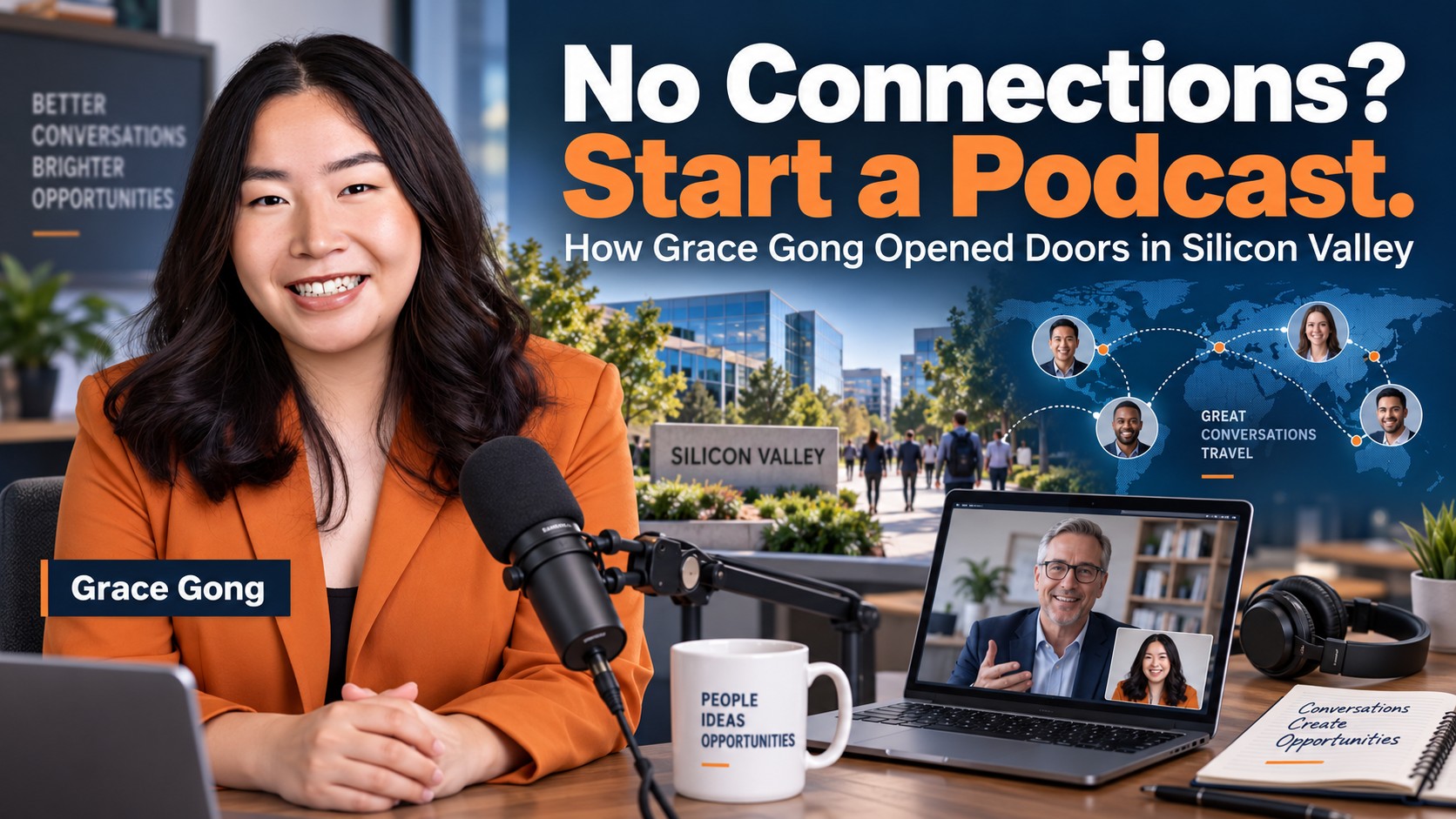
How Podcasting Helped Grace Gong Build a Network in Silicon Valley
Grace Gong arrived in the United States as an international student without an established business network. In Silicon Valley, she noticed that some people encountered experienced executives through the campuses and companies they already belonged to. Other people didn't have those introductions.
She wanted to create a learning opportunity for her younger self. Smart Venture Podcast became a way to hear from technology leaders, investors, and executives whom listeners might never meet on their own.
When I spoke with Grace on episode 1053 of Marketer of the Day, she kept returning to the audience. The question wasn't only which successful person she could meet. It was what those people could help listeners understand.
You can watch our conversation. The useful lesson for a business podcast is straightforward: choose the question and the people it serves before treating the guest's status as the reason to record.
Build something a specific person needs
Grace had tried a version of that approach before podcasting. In high school in China, she started an English-language newspaper covering students' extracurricular activities. Friends contributed stories. Students applying abroad purchased copies to include in their application materials.
The publication had a purpose beyond giving Grace something to publish. It helped students document what they were doing, and she described it becoming one of the school's largest student organizations.
Her original career idea wasn't podcasting either. She wanted to attend film school and write comedy, applied to graduate film programs, and was rejected by all of them. Looking back, she recognized that the creative process appealed to her even if writing scripts wasn't the only place to use it.
Business, interviews, and presenting ideas gave that interest another outlet. Those experiences don't make a universal career formula. They help explain why her show was built around offering access and learning, rather than collecting famous names.
For your own show, finish a more specific sentence than "I interview successful people." Who needs to understand something, and whose experience is difficult for them to access? A question like that gives you a way to select guests and decide what the conversation should cover.
- 1. Picture the person without accessName the question your audience can't easily ask an experienced professional.
- 2. Choose useful experienceFind the guest who can explain it, regardless of title or following.
- 3. Listen beyond the outlineUse relevant audience questions and follow-ups to deepen the interview.
- 4. Publish and make roomAssign production so you can deliver the episode and continue a real exchange.
Choose the experience that makes the episode useful
I asked Grace about interviewing executives from companies such as Google, Meta, and Chipotle alongside specialists in other roles. She didn't particularly like treating them as higher- and lower-status guests. They offered different experience for different listeners.
Someone with decades of leadership experience might explain a broad decision. A specialist working directly with a technology or investment category may understand the immediate details better. Neither job title answers the question of what this audience needs.
Grace recalled interviewing a former Chipotle CEO who spoke with employees and went through company training undercover. What stuck with her was the example of listening and empathy: a person making decisions took time to experience work farther from the executive desk.
The company name catches attention. The behavior gives a listener something to examine. What changes when a leader experiences the process employees are expected to follow instead of relying entirely on reports?
Keep the source of that example clear. It's Grace recalling a story from her interview, not a project I witnessed or a measured claim about what the training produced. The useful part is the leadership question it opens.
Match the guest to the question, not the other way around
For a business show, I'd make the choice visible before sending an invitation. You don't need to be equally interested in every accomplished person who agrees to talk.
| Audience need | Useful kind of experience | Preparation question |
|---|---|---|
| Understand a major leadership decision | Someone who made or closely examined that decision | What did they consider, and what changed their view? |
| Learn the current work behind a specialty | A practitioner dealing with it directly | Which problem keeps appearing, and what do outsiders misunderstand? |
| See a customer's difficult choice | Someone who can appropriately share their experience | What information did they need before deciding? |
| Explore an unfamiliar field | A guest who can explain it without assumed knowledge | What would a thoughtful newcomer need explained first? |
Grace suggested listeners begin with an episode relevant to their industry. That's a useful reminder for hosts too. The best starting episode for one person may be irrelevant to another. A larger name isn't a substitute for a clear subject.
Suppose a consultant serves smaller manufacturers whose managers want to understand employee training. An operations leader with direct experience may be a stronger fit than a famous guest whose usual discussion doesn't touch the problem. That's a hypothetical application of the audience-first choice, not a claim from Grace's client work.
Your invitation can then say what you want to explore and why the experience matters. The guest isn't being asked to be impressive for thirty minutes. They're being invited to help explain something.
Leave room for questions you didn't prepare
Grace described a LinkedIn Live interview with a climate technology investor where audience questions went deeper than some she'd prepared. People listening brought experience and concerns the host didn't necessarily share.
That doesn't mean you need a daily live show. At the time of our March 2024 conversation, Grace described an ambitious weekday schedule for Venture with Grace. It was her approach then, not a requirement for your business or a statement of her current broadcasting schedule.
You can collect questions before a recorded interview. Ask customers what they find confusing, note replies to earlier episodes, or invite relevant subscribers to submit a concern. Use the answers to improve the conversation rather than surrendering the show's direction to every suggestion.
Grace also described discovering a wider audience than she originally imagined. In March 2024 she reported reach in more than 110 countries, beyond the venture-capital and technology listeners she'd initially pictured. That's a reported geographic reach at that time, not a regular-listener count, revenue figure, or current audience claim.
Start with someone specific in mind, then listen when actual responses show another useful angle. You can remain focused without assuming your first audience description was complete.
The company name catches attention. The behavior gives a listener something to examine.
Protect time for the exchange you wanted to have
Near the end of our interview, Grace turned the conversation around and asked about my services. That surprised me. I'd been asking about her shows and experiences, and she made room for me to explain work connected to what we were discussing.
I described how DFY Podcast helps with production, show notes, publishing, videos, and graphics. That was the exchange. It doesn't establish that Grace became a customer or that we formed a business partnership, and I wouldn't turn it into either claim.
The moment matters because a useful interview can create room for professional give-and-take. You can't schedule an ongoing relationship into existence. You can prepare well, listen, and leave room for the other person's interests.
Grace also noticed that experienced professionals often found collaborators with complementary strengths instead of trying to become equally capable at everything. I can relate to that. School may require you to take the chemistry test yourself. Running a business gives you more choice over who handles the recurring work.
For a host, protect the parts requiring your involvement: deciding what matters, preparing questions, listening, and following through. Give editing, episode preparation, and publishing a clear owner. Otherwise, you can spend so much time producing content about relationships that you have little attention left for the people you've met.
Related conversations and resources
- Smart Venture Podcast
- Venture with Grace
- Grace Gong's Interview on Marketer of the Day, Episode 1053
Choose one reachable person and a question worth sharing
You don't need an executive calendar like Grace's to borrow the useful part of her approach. Start with an audience question, identify someone with relevant experience, and make a respectful invitation.
Before filling the calendar, decide how the recording will get finished and delivered. Choose a pace you can maintain alongside the rest of your business. A smaller number of published, useful conversations gives you more to work with than an impressive list of unfinished recordings.
If you know whom you want to interview but editing and publication keep delaying the idea, bring that audience question and guest idea to our podcast production page. At DFY Podcast, we help turn the conversation into an episode while you keep your attention on the person you invited and the people the answer could help.