
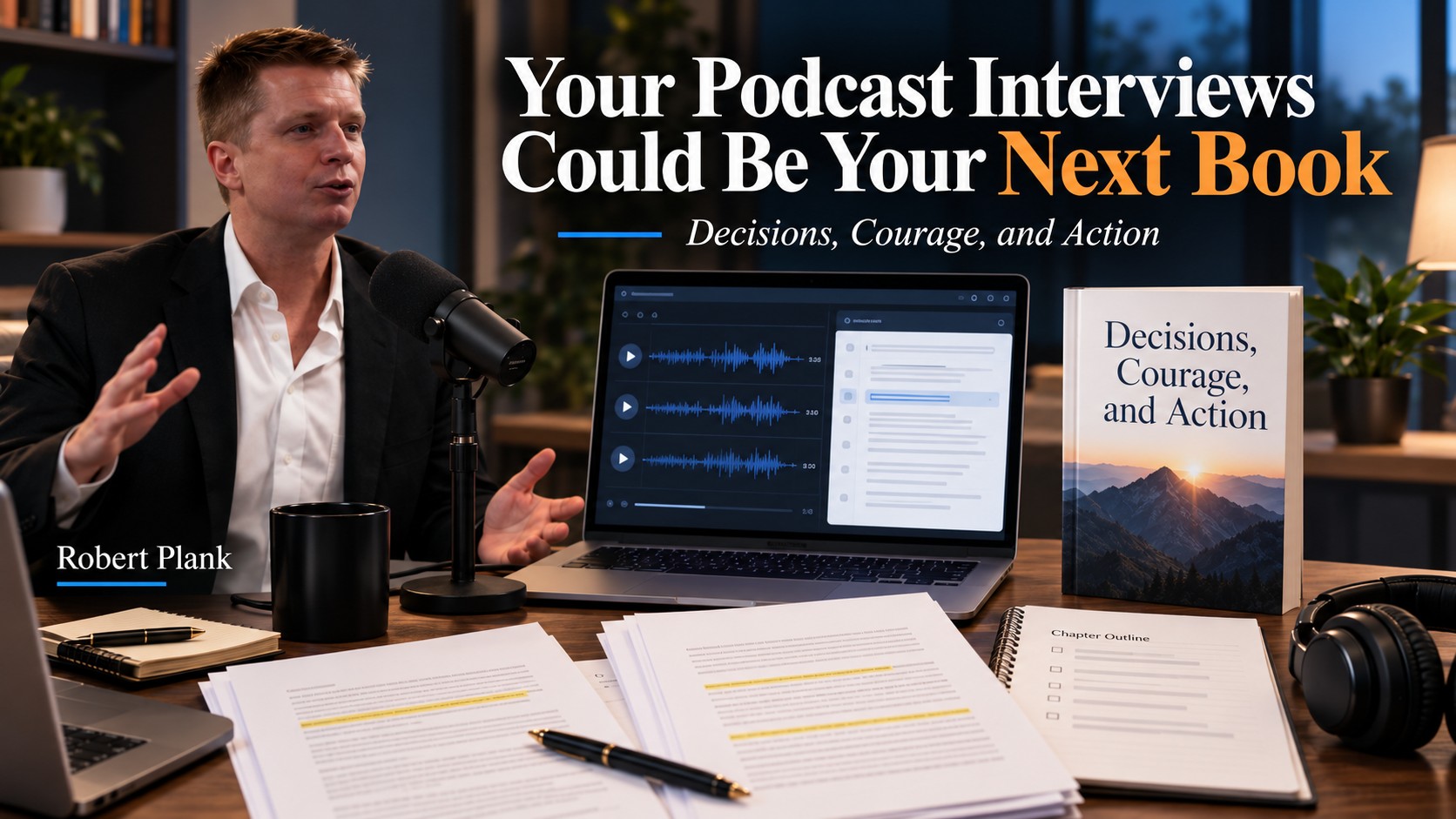
How I Turned Podcast Interviews Into a Book: Decisions, Courage, and Action
I had useful podcast interviews sitting in the archive. We'd recorded the conversations, published them, sent the guests their links, and moved on. Some contained stories and explanations worth more than one appearance in the release schedule.
I wanted to turn selected interviews into a book. That became Decisions, Courage, and Action, with nine other main contributors and my own chapter. The work was choosing a shared purpose, developing readable chapters, incorporating contributor corrections, and finishing the editions.
The campaign launched October 1, 2026, with promotional material for contributors and outreach to people I'd interviewed before. Getting there involved manuscript versions, approval messages, and the separate work of producing print, ebook, and audio editions.
The useful case study is how the recordings became something people could read, hear, approve, and share. That process began with a question for the reader, not a folder of transcripts and a cover.
Choose the Question That Holds the Book Together
The archive included leadership, fear, decision-making, burnout, and getting things done. Those subjects connect, but they don't automatically make one book. I needed a reason for a reader to move from one contributor's experience to the next.
For this collection, the question was how to make difficult decisions, find the courage to act, and follow through. That gave me a way to select material. The guest didn't need to say the book's title during the interview. Their experience needed to explain part of that problem.
Chapters such as "Decision Speed with Human Judgment" and "The Best Is in the Middle" approach choices from different directions. My chapter, "Five Little Boxes: A Tool-Proof Way to Solve Hard Problems With AI," adds the work of organizing messy information and shaping it into something useful.
During a separate conversation with Mark Osborne on compilation books, I used the phrase "the unifier is you." The contributors supply experiences and ideas. The person assembling the book has to select, organize, and explain why they belong together.
I'd rather have eight chapters answering a useful question than twenty included simply because twenty people agreed. The number isn't the editorial argument. The reader needs to see how the contributions help them make progress.
From Recorded Conversations to a Contributor Book
- 1. Choose the shared questionSelect interviews that explain parts of the same reader problem.
- 2. Develop the chaptersOrganize the substance so it works without the original interview.
- 3. Incorporate contributor reviewMake corrections and identify the approved version.
- 4. Prepare each editionTrack manuscript, submission, live status, and delivery separately.
- 5. Give people useful launch materialConnect relevant chapters with contributor and guest audiences.
Turn the Conversation Into a Chapter
A podcast has a host to guide the discussion. I can clarify a term, bring someone back to an earlier point, or ask for the missing part of a story. A chapter needs to carry the reader without that exchange happening beside them.
As I explained in contributor correspondence, "I didn't want to turn the episode into a transcript with better punctuation." I needed a central idea, an opening that established the reader's problem, examples in an understandable order, and less repetition.
Suppose an interview discusses two managers assigning conflicting deadlines. That's an illustration of the editing task. The guest may explain the situation in pieces as the host asks questions. On the page, those pieces need an order that makes the conflict, decision, and consequences clear.
My test was whether someone could open the chapter without having heard the episode and understand the idea well enough to use it. Cleaning grammar helps, but it doesn't settle that question.
Each chapter also needed a file, a consistent title, the correct contributor name, and a connection to the source interview. A correction is useful only if it reaches the current manuscript instead of another file with nearly the same name.
Use AI With Editorial Checkpoints
AI can generate a convincing chapter that changes the guest's thinking. It may remove an unusual example, supply advice the person never gave, or turn a qualified observation into a tidy rule. The more polished it sounds, the easier that can be to miss.
In "Five Little Boxes," I described the division this way: "The transcript supplied the substance, while AI helped organize, condense, compare, and reshape it." I still had to decide whether the output was accurate and worth developing.
Start with the reader problem and source material. Develop the premise, identify useful stories, organize an outline, and work toward a draft. Between those stages, compare the developing chapter with the interview. Restore the example that makes the idea understandable and remove claims the source doesn't support.
That describes my editorial approach, not a claim that every chapter used an identical chain of prompts. Sometimes the useful answer comes near the end of the interview and needs moving. Sometimes the wording reads well but sounds nothing like the contributor.
A shaped draft becomes the next working input. It doesn't become approved merely because a tool produced it. Keep the contributor's actual language, specific decisions, and important limits where they do the teaching.
Make Contributor Approval a Real Production Step
I approached contributors with a usable draft and an explanation of why their interview belonged in the collection. They could judge the proposal from actual material instead of agreeing to an unspecified interpretation of their ideas.
I made contributor approval part of the process. In the same correspondence, I also said, "The chapter is yours either way." The person needed room to decide whether the draft represented them.
Nothing is published under your name until you approve it.
There were corrections to incorporate. On August 25, 2026, I confirmed to one contributor, "I've integrated your changes into the current copy, attached!" That's a small operational detail with a useful distinction behind it: offering review and actually applying the edits are separate jobs.
I also defined participation packages. An offer to Jason M. Riggs listed editing and revisions, biography and website information, book and audiobook inclusion, a personal mini-book, printed copies, and 30 days of promotion. Putting the work in writing made the proposed responsibilities visible before he agreed.
The package defined work I could undertake. I didn't guarantee a sales total, bestseller designation, advertising result, or Amazon ranking. State the work, the approvals, and the delivery responsibilities instead of promising a marketplace outcome.
Before proceeding, keep the contributor arrangement and approved chapter together. If the contributor corrects a fact, that correction needs to travel into the manuscript and the editions produced from it.
Track the Editions Through Separate Milestones
The finished manuscript was an important step, but it wasn't the same as every edition being available and every contributor receiving a box of books. Different formats had their own work and timing.
| Date | What I reported | Production distinction |
|---|---|---|
| September 14 | Kindle and paperback editions submitted to Amazon. | Submission is separate from being live or physically delivered. |
| September 28-29 | Two days narrating the audiobook, followed by an upload update. | Recording and uploading are separate from distribution approval. |
| October 1 | Campaign launch. | A promotion date doesn't mean every production task is finished. |
| October 4 | An epilogue update with Reena Friedman Watts's "Record It While You Can." | A changed manuscript needs tracking across the editions. |
| October 7 | Audiobook reported live on Audible. Printed contributor copies still needed handling. | Live digital editions and contributor delivery are different milestones. |
Reena Friedman Watts contributed an epilogue rather than another numbered main chapter. The updated manuscript placed it on printed page 287. That mattered when describing the lineup: the collection still had its original ten numbered chapters.
Narrating also made version control particularly important. I needed the appropriate manuscript, correct pronunciations, and text that worked aloud. An updated PDF on my computer didn't automatically update the audio or every published edition.
I distinguish between the file being finished, the edition being submitted, the edition being live, and the physical product being delivered. Give each state a place in the production record so an encouraging progress update doesn't hide an unfinished obligation.
The audiobook listing is one outcome of that work. If you have an approved manuscript ready for audio, Done For You Narration can help you plan and produce the audiobook as its own project.
Give Contributors Something Useful to Share
The book gave me a reason to reconnect with people I'd interviewed. When I contacted Steve Young, I could connect our earlier conversation and his interest in AI with the chapter on decision speed and human judgment. I could ask whether he wanted the book link and a short post he could use.
That is a different request from sending everyone a cover image and asking for promotion. Revisit the conversation and find the part of the book relevant to that person.
We prepared graphics, direct links, LinkedIn wording, and editable contributor articles. One article used the problem of a middle manager facing competing deadlines. It could help a reader handle conflicting priorities while connecting naturally to a contributor's chapter.
The contributor could edit the article and suggested wording for their audience. I also wanted the links to anything they published so I could share their versions and draw attention to their expertise. Preparing the kit didn't establish that every recipient used it, but it removed the blank page from the request.
We also ran a free Kindle promotion ending October 5. That gave people a specific opportunity to share the ebook. Other publicity and advertising work had separate preparation and submission steps, so I kept those tasks distinct from confirmed publication.
Keep the Launch Numbers in Their Proper Categories
My October 7 wrap-up reported 783 copies processed between September 24 and October 6. That period included free Kindle promotion, so I treat it as a reported distribution total. It doesn't establish paid revenue, profit, or how many recipients finished reading.
For the next project, I'd keep separate records for free distribution, paid purchases, reviews, production expenses, and publicity. A commitment to promote isn't a completed post. A category position is a snapshot, and a distributed release isn't automatically an independent review.
Test the Book Idea With a Few Strong Interviews
Begin with interviews where a guest explained a decision, a practical method, or an experience that would remain useful without the recording. Look for the question those conversations might answer together.
Develop two or three into standalone chapters before recruiting a large group. Give each a clear purpose, compare the draft with the interview, and ask the contributor to review it. You'll learn whether the collection has an editorial center before multiplying the coordination work.
If you want help evaluating that material and planning the production, visit DFY Podcast's production page. Bring a few episodes and the reader you want the book to serve so we can discuss the editorial, contributor, and publishing work needed to give those conversations another life.